
Sodium Nitrite Liquid or Powder for Closed Cooling Loops in Salalah
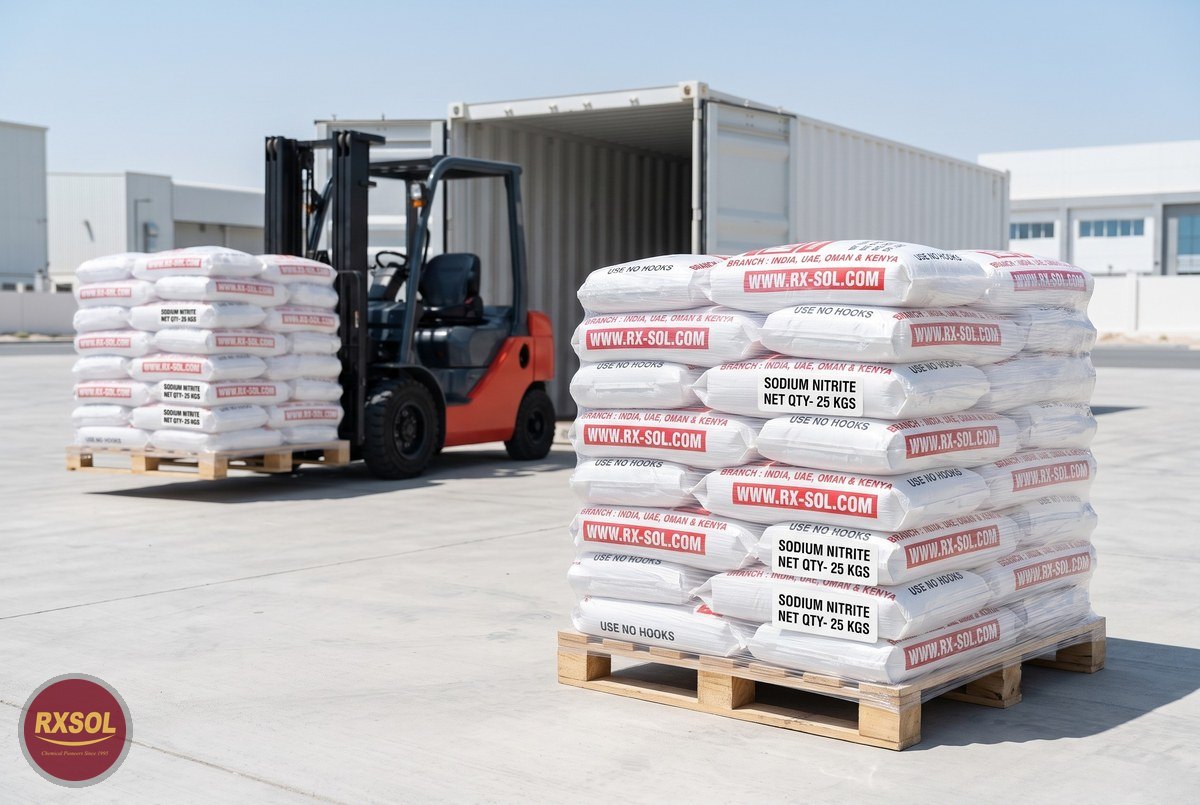
If the nitrite residual in your closed cooling loop keeps falling, you need a measured top-up of sodium nitrite liquid or powder, and the form you choose decides how easily your team can dose it. Sodium nitrite (NaNO2, CAS 7632-00-0) protects carbon steel in chilled and hot water loops when you hold it at the right ppm. For most Salalah plant loops fed by a dosing pump or pot feeder, the liquid is the simpler form to handle. The powder suits sites that make up their own solution and want to ship less water. We supply Sodium Nitrite Liquid Solution, part number RXSOL-68-1525-025, from our Barka warehouse with delivery to Salalah and Dhofar.
What Is Sodium Nitrite Liquid?
Sodium nitrite is sold as a solid or as a liquid, and the liquid is typically a 40% solution in water. Buyers also call it sodium nitrite solution or sodium nitrite liquor. A typical 40% solution is a clear, colourless to pale yellow, odourless liquid with a density of about 1.3 g/mL. It is miscible with water, with a typical boiling point of about 115 °C and a freezing point of about -1 °C, depending on concentration.
The safety data sheet for our liquid lists sodium nitrite at 15-30 % by weight. Ask us for the exact strength of the batch with your quote, because every dose figure below depends on it. The powder is a white to slightly yellowish, hygroscopic crystalline solid, and technical grade is typically 98.5-99% or higher NaNO2.
How Nitrite Protects Steel in a Closed Cooling Loop
A closed cooling system recirculates its water without air contact or evaporation, so it needs little makeup water and holds its inhibitor for a long time. Nitrite is one of the common treatments for these loops, alongside molybdenum, silica, azoles and pH control. A typical nitrite programme pairs sodium nitrite for carbon steel with an azole for copper and brass, a borate buffer and a non-oxidising biocide. For copper protection, system pH is typically held at 9-9.5.
Nitrite has to stay above a floor. A minimum of about 500 ppm sodium nitrite (about 335 ppm nitrite) is commonly maintained, because low nitrite can allow pitting. One published case study recommended holding nitrite at 600-800 mg/L at all times, with a minimum residual of at least 5 times the combined chloride and sulfate concentration.
Sodium Nitrite Liquid or Powder: Which Suits Your Salalah Plant?
Choose the liquid if you dose with a metering pump or a bypass pot feeder. Nitrite closed loop liquids are fed neat, so there is no dissolving tank and no dust at the hatch, and you measure the dose by volume. The solution is stable in transport and stores at ambient temperature. The trade-off is freight: a 40% liquid is about 60% water, and a weaker solution carries more.
Choose the powder if your loop is large, your site has a mixing tank and you want the least weight per kilogram of active nitrite. You must dissolve it fully before it goes into the loop, keep the bags sealed because the solid is hygroscopic, and manage it as a Class 5.1 oxidiser. During the khareef from June to September, humid air in Dhofar warehouses makes opened bags cake quickly. Nitrite, borax and azole blends also come as slow-dissolving tablets for pot feeders, stored below 30 °C.
Target Nitrite Levels for Chilled and Hot Water Loops
Typical control ranges are 400-700 ppm as NO2 (600-1,050 ppm as NaNO2) for chilled loops and 800-1,000 ppm as NO2 (1,200-1,500 ppm as NaNO2) for hot loops. Formulated nitrite inhibitors typically target 500-1,000 ppm as NaNO2 in the system water.
Your test kit decides which column you read. To convert a result from ppm NaNO2 to ppm NO2, multiply by 0.67, and to go the other way, divide by 0.67. A drop-test kit reading of 400 ppm as NO2 is about 600 ppm as NaNO2, the bottom of the chilled range. Check the kit label before you log a residual, because a reading taken on the wrong basis is out by about a third. Nitrite is typically checked with a drop-test kit or a colour-disc comparator.
Dose Calculation: How Much Sodium Nitrite per Cubic Metre
One ppm in one cubic metre of water is one gram. So 1,000 ppm as NaNO2 in 1 m3 needs about 1 kg of pure NaNO2, which is about 2.5 kg (about 1.9 L) of a 40% solution. The working formula is: kg of pure NaNO2 = loop volume in m3 x ppm rise as NaNO2 / 1,000. Divide that by the product strength (0.40 for a 40% solution) to get kg of product.
A 50 m3 chilled loop charged from fresh water to 800 ppm as NaNO2 needs 40 kg of NaNO2. That is 100 kg of a 40% solution, about 77 L, or 160 kg of a 25% solution. A top-up on the same loop from 500 to 800 ppm needs 15 kg of NaNO2. A 200 m3 hot loop raised to 1,200 ppm as NaNO2 needs 240 kg of NaNO2, about 244 kg of 98.5% powder.
Why Nitrite Drops: Leaks, Chloride, Oxygen and Bacteria
Nitrite loss in closed loops comes from leaks, oxygen ingress through leaking heat exchangers and microbial growth. In one documented case, falling nitrite was followed by rising iron and pitting up to about 90% of wall thickness. Nitrite-oxidising and nitrite-reducing bacteria consume the inhibitor, so a non-oxidising biocide belongs in the programme. Pre-commissioning flushing and sidestream filtration are recommended.
Salalah adds chloride risk. A seawater-side exchanger failure at a coastal plant or port site pushes chloride into the loop, and the 5 times chloride plus sulfate rule then raises the nitrite you must hold. Test chloride alongside nitrite, and keep a buffer stock on site so a delivery gap does not leave the loop under-treated.
Closed Loops at Salalah Free Zone Plants, Raysut and Dhofar Cold Stores
Closed loops serve compressors, turbines and process coolers at industrial plants, equipment at ports, and chiller loops in cold stores and fish processing plants. Nitrite is one of the common treatments for loops like these. At ammonia and fertiliser sites, store nitrite well away from ammonium salts. In food plants, keep loop chemicals out of every product area: food curing uses food grade nitrite only, and a cooling loop product is not food grade.
Metals, Glycol and When Not to Use Sodium Nitrite
Nitrite closed loop liquids protect iron, steel, brass and copper, with an azole for the yellow metals. They are not recommended for systems containing aluminium. For galvanised steel, zinc or soft solder in older building chilled water systems, send us the system metallurgy before you dose. Sodium nitrite has a long record as an inhibitor in antifreeze fluids, so glycol loops can use it; confirm compatibility with your glycol supplier.
Nitrite is the wrong choice for open cooling towers, where air contact and bacteria convert it to nitrate. It must not reach potable water. Sodium nitrite carries H400, very toxic to aquatic life, so do not drain a treated loop to sea or sewer without approval.
Packing, Storage and Safe Handling in Dhofar Heat
| Item | Detail |
|---|---|
| Product | Sodium Nitrite Liquid Solution |
| Part number | RXSOL-68-1525-025 |
| Composition (our SDS) | Sodium nitrite, CAS 7632-00-0, 15-30 % wt |
| Application | Corrosion inhibitor; water treatment, anti-freeze fluids, industrial cleaners and lubricants |
| Typical closed loop control | Chilled 600-1,050 ppm as NaNO2; hot 1,200-1,500 ppm as NaNO2 |
| Packing | 25 Ltr, 50 Ltr and 210 Ltr |
| MSDS | On request |
Sodium nitrite solution irritates the eyes, nose and throat and can cause skin burns on prolonged contact. Swallowing it can cause cyanosis, a fall in blood pressure, collapse and death. Wear impervious clothing and goggles. The solution is not flammable but becomes a strong oxidiser when the water evaporates, so it can intensify fires and give toxic nitrogen oxides. Do not use ammonium phosphate dry chemical extinguishers.
Store drums cool and out of direct sun, away from acids, ammonium salts, amines, cyanides, reducing agents, combustibles, food and feed. Acids release toxic nitrogen dioxide. Dried residue on wood, paper or textiles is a fire hazard, so wash spills off wooden pallets and discard soaked rags. Stop a spill and keep it out of water intakes. Solid sodium nitrite ships as UN 1500, Class 5.1, Packing Group III.
Where to Buy Sodium Nitrite Liquid in Salalah
Salalah Chemical (RXSOL group, Oman) supplies sodium nitrite liquid from our Barka warehouse, with deliveries to Salalah and Dhofar. Call +968 77333599, message us on WhatsApp or email muscatchem@gmail.com. Send your loop volume, metallurgy and current residual and we will confirm the strength, packing and quantity. You can compare other inhibitors in our cooling water chemicals range or browse all our products. If you also run plants in the north, the same sodium nitrite liquid solution is listed for Muscat deliveries and for Sohar port and industrial area sites.
Frequently Asked Questions
Is liquid or powder sodium nitrite better for a closed cooling loop?
Liquid suits pump and pot feeder dosing, with no dissolving and no dust. Powder suits large loops with a mixing tank and ships less water, but you must keep it dry and dissolve it fully.
How much sodium nitrite do I need per cubic metre?
About 1 kg of pure NaNO2 per m3 for 1,000 ppm as NaNO2, which is about 2.5 kg (about 1.9 L) of a 40% solution. Scale by your target ppm and the strength of the product you buy.
What is the difference between ppm as NO2 and ppm as NaNO2?
They report the same nitrite on different bases. Multiply ppm NaNO2 by 0.67 to get ppm NO2, and check which basis your test kit reports before you compare with a target range.
Why does the nitrite level in my closed loop keep dropping?
The usual causes are leaks, oxygen ingress through leaking heat exchangers and bacteria that consume nitrite. Find the losses, test chloride and add a non-oxidising biocide.
Can sodium nitrite be used in systems that contain aluminium?
Nitrite closed loop inhibitors are not recommended for systems containing aluminium. Send us your metallurgy and we will advise.
Request a quote for sodium nitrite liquid for your Salalah loop on WhatsApp at +968 77333599 or through our quote request page.
Frequently asked questions
Is liquid or powder sodium nitrite better for a closed cooling loop?
Liquid suits pump and pot feeder dosing, with no dissolving and no dust. Powder suits large loops with a mixing tank and ships less water, but you must keep it dry and dissolve it fully.
How much sodium nitrite do I need per cubic metre?
About 1 kg of pure NaNO2 per m3 for 1,000 ppm as NaNO2, which is about 2.5 kg (about 1.9 L) of a 40% solution. Scale by your target ppm and the strength of the product you buy.
What is the difference between ppm as NO2 and ppm as NaNO2?
They report the same nitrite on different bases. Multiply ppm NaNO2 by 0.67 to get ppm NO2, and check which basis your test kit reports before you compare with a target range.
Why does the nitrite level in my closed loop keep dropping?
The usual causes are leaks, oxygen ingress through leaking heat exchangers and bacteria that consume nitrite. Find the losses, test chloride and add a non-oxidising biocide.
Can sodium nitrite be used in systems that contain aluminium?
Nitrite closed loop inhibitors are not recommended for systems containing aluminium. Send us your metallurgy and we will advise.